
So you run a coaching center. You’ve moved your mock tests online, your batch has grown from 80 students to 800, and one morning you get the message every institute director dreads: “Sir, the JEE mock questions are floating around on a Telegram group.”
Here’s the uncomfortable truth about 2026 — the moment your exam goes online, a student with a second phone and a ChatGPT tab can quietly out-answer your toppers. And they will, unless something is watching. That “something” is online proctoring software for online exams, and this guide walks you through what it actually is, what’s changed this year, what it costs, and — the question you probably typed into Google — where you can buy it for your coaching center.
Let’s talk like humans, not like a spec sheet.
Quick answer (for the folks in a hurry)
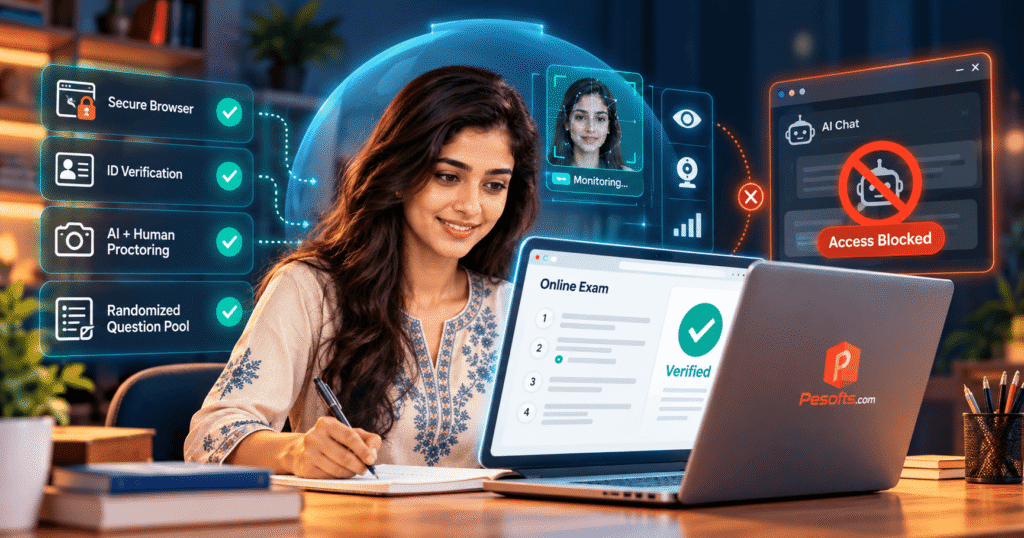
Online proctoring software for online exams is a tool that monitors students through their webcam, microphone, and browser during a remote test, uses AI to flag cheating in real time, and gives you an audit trail of every violation. In 2026-27, the best systems specifically block AI tools like ChatGPT, Gemini, and Claude at the browser level, detect secondary phones, and pair automated AI
monitoring with live human review.
If you’re a coaching center in India and want the short version: you can buy it directly from Pesofts, starting free for up to 50 students, and you can book a free live demo here to see it working on your own exam before you pay a rupee.
Now, the full story.
Why 2026 broke the old way of doing exams
For years, “proctoring” meant a webcam recording that someone might review later. That model was built before ChatGPT existed. It’s now obsolete, and the data says so.
The online proctoring software market was valued at around USD 1.36–1.49 billion in 2025-26 and is on track to keep climbing at double-digit growth through the early 2030s, with some analysts projecting the wider category to cross USD 8 billion by the mid-2030s. That’s not hype — it’s institutions realizing that remote exams without real monitoring are basically an honor system, and the honor system lost.
The reason it lost has a name: generative AI.
- Multiple 2026 studies report that roughly 62-63% of students admit to attempting to use ChatGPT or similar tools during online exams.
- Purpose-built “invisible” cheating extensions now read a question from a screenshot and generate an answer in seconds.
- Traditional plagiarism checkers and AI-text detectors are unreliable once a student lightly edits the AI’s output — accuracy drops sharply.
Translation for a coaching center owner: if your mock test platform can’t active
ly stop AI use during the exam, your rank list is fiction. And a fake rank list is an existential problem — parents pay you precisely because your ranks are trusted.
This is the single biggest shift of 2026-27: proctoring stopped being about catching a student looking away from the screen, and became about defending your exam against an AI sitting in the next tab.
What online proctoring software actually does (in plain language)
Think of it as a strict-but-fair invigilator who never gets tired, never takes a chai break, and watches every student in every batch simultaneously. Here’s what a modern system handles:
Identity check at login. The software captures the student’s face and photo ID so the person taking the exam is the person getting the marks. No more “my cousin wrote my mock test.”
Continuous face monitoring. AI facial recognition watches for a face leaving the frame, a second face appearing, or one person being swapped for another mid-exam. Every incident is logged with a snapshot and timestamp.
Browser and tab lockdown. This is the big one for the ChatGPT era. A secure browser prevents opening new tabs, new windows, or search engines. The student physically cannot pull up ChatGPT, Gemini, Claude, a translator, or a VPN in the exam window. Any attempt fires an instant alert.
Phone and secondary device detection. Because a locked browser doesn’t help if the student just picks up a second phone under the desk. Good software reads the digital signature of nearby devices and flags them.
Smart voice and audio detection. The sneaky workaround is voice assistants — “Hey Siri, open ChatGPT” or “OK Google, what’s the answer to…” Modern systems listen for exactly these trigger phrases and alert a live proctor.
Screenshot and copy blocking. Stops students from photographing your question bank and leaking it — protecting the paper you spent weeks building.
Live proctor dashboard. Admins see every active session in one screen, with suspicious activity flagged by AI so a human can step in and confirm.
Auto-submission on violations. Set a threshold — say, three violations — and the system auto-submits the cheater’s paper and notifies you. Zero manual babysitting.
If you want to see each of these demonstrated on a real exam scenario, that’s exactly what the Pesofts AI proctoring demo walks through, feature by feature.
The 2026-27 anti-cheating stack that actually works
Here’s what industry practitioners now agree on — no single feature stops cheating. It’s a layered system. The proven baseline for a remote exam looks like this:
- Secure browser (blocks the AI tools and search engines)
- Identity verification (right person, verified in ~60 seconds)
- AI proctoring with record + human review (catches the behavioral stuff)
- Randomized question pools (pull each paper from 200-300 questions, shuffle options)
Layer these and you cut remote cheating by roughly 85-90%. Add two more moves that leading institutions are adopting in 2026 for high-stakes tests:
- Personalised question variants — each student gets slightly different numbers or datasets, so a shared answer key or a copy-pasted ChatGPT reply simply doesn’t fit.
- Application-based, open-ended questions — far harder for an AI to answer cleanly than plain factual recall, which raises the “cost of cheating” for the student.
The lesson: technology stops the obvious, and smart exam design closes the rest. Your proctoring vendor should support both.
“Where can I buy online proctoring software for my coaching center?”
This is the actual question a lot of you came here to answer, so let’s be direct instead of coy.
You have broadly three routes:
1. Global platforms (ProctorU, Honorlock, Mettl, Proctorio). Powerful, but priced for Western universities and enterprises — often USD 15-25 per student per exam. For an Indian coaching center running lakhs of mock attempts a year, the math gets brutal fast. Many also lack mobile screenshot blocking and India-based support that understands JEE/NEET/UPSC/SSC patterns.
2. Building your own. Don’t. The 2026 compliance and AI-detection requirements — behavioral analytics, data-retention rules, hybrid AI-plus-human review — are a multi-year engineering project. Retrofitting a Chrome extension is not the same as a purpose-built platform.
3. An India-first specialist like Pesofts. This is the practical answer for most coaching centers reading this.
Here’s an honest, side-by-side look at how Pesofts positions against the global names — the kind of comparison you’d otherwise have to piece together yourself:
| Feature | Pesofts | ProctorU | Mettl | Honorlock |
|---|---|---|---|---|
| AI Facial Recognition | ✅ | ✅ | ✅ | ✅ |
| Phone / Secondary Device Detection | ✅ | ❌ | ✅ | ❌ |
| Screenshot Blocked on Mobile App | ✅ | ❌ | ❌ | ❌ |
| Inbuilt Payment Gateway | ✅ | ❌ | ❌ | ❌ |
| White-Label Branding | ✅ | ❌ | Paid add-on | ❌ |
| Android + iOS App | ✅ | ❌ | ✅ | ❌ |
| AI Question-Leak Detection | ✅ | ❌ | ❌ | ✅ |
| Free Plan (up to 50 students) | ✅ | ❌ | ❌ | ❌ |
| India-Based Support Team | ✅ | ❌ | ✅ | ❌ |
Comparison as presented on the Pesofts demo page; verify current features on a live demo before purchase.
The practical takeaway: for an Indian coaching center, the deciding factors are usually price per student, a mobile app that actually blocks screenshots, white-label branding so it looks like your institute, and a support team that picks up the phone and speaks your exam language. That’s the niche Pesofts is built for.
You can start on the online proctoring software system page or jump straight to a free personalised demo — the free tier covers your first 50 students with no credit card.
How much does it cost — and how do you actually start?
Straight talk on pricing: for Indian coaching institutes, expect the entry point to be free (Pesofts offers up to 50 students at no cost, no time limit), with paid plans scaling by student volume and features. That’s a dramatically different economic model from the per-student pricing of global platforms.
The onboarding path is refreshingly simple:
- Fill the demo form (under 60 seconds, no credit card).
- Get a callback within 24 hours to discuss your exam type.
- Join a live demo where they run your kind of exam — MCQ, CBT, subjective, or mixed.
- Run your first proctored exam free for up to 50 students.
No procurement committee, no six-month pilot. For a coaching center, that’s the whole point.
Who’s this really for?
Online proctoring isn’t only for giant universities. In 2026-27 it’s being adopted by:
- Coaching institutes running JEE, NEET, UPSC, SSC, and banking mock tests — scaling from 50 to 50,000 students without paper leaks.
- Schools and colleges conducting semester and unit tests without renting exam halls and hiring invigilators.
- Universities handling large-scale entrance and end-semester exams with full audit logs.
- Corporate and HR teams screening candidates with cheat-proof aptitude tests.
- Certification bodies issuing credentials backed by tamper-proof records.
- EdTech platforms adding a white-labelled proctoring layer via API.
If any of those is you, the technology has matured to the point where not using it is the risky choice.
A quick word on privacy (because students will ask)
Worth being upfront: a real 2023 survey found roughly 48% of students felt uncomfortable with webcam-based monitoring. That discomfort is legitimate, and in 2026 there’s growing regulatory attention on biometric data, consent, and retention. The right approach isn’t to ignore it — it’s to be transparent with students about what’s recorded, why, and for how long, and to choose a vendor that pairs AI flags with human judgment rather than auto-punishing on an algorithm’s guess. Fair monitoring, clearly communicated, is what keeps trust intact. Proctoring done well is a resource for honest students — it protects the value of the rank they earned.
Frequently asked questions
What is online proctoring software for online exams? It’s software that monitors students during a remote exam through their webcam, microphone, and browser, using AI to detect cheating — face substitution, tab switching, secondary phones, voice-assistant use, screenshot attempts — and logging every violation for review. Modern 2026 systems also block AI tools like ChatGPT at the browser level.
Can online proctoring software stop ChatGPT cheating? Yes, when it’s built for it. A secure browser blocks AI chatbots and search engines from being opened during the exam; smart voice detection catches “Hey Siri / OK Google” attempts to reach an AI verbally; and phone detection flags a second device. No single feature is enough — the layered stack is what works.
Where can I buy online proctoring software for my coaching center? You can buy directly from India-first providers like Pesofts, which offers a free plan for up to 50 students and paid plans priced for Indian institutes. Book a free demo to test it on your own exam first.
Does it work on mobile? Good platforms run on web plus Android and iOS apps, with screenshot capture blocked on all of them — a feature many global platforms still lack on mobile.
Is it affordable for a small coaching institute? Yes. The starting tier is free for up to 50 students, and paid plans are among the most affordable in the market, which is why the model suits Indian coaching centers far better than per-student global pricing.
Can it handle thousands of students at once? Yes — modern platforms run unlimited concurrent exams across batches with AI monitoring every session in real time. Pesofts reports powering over 50 lakh exam attempts across India.
The bottom line
Online exams aren’t going anywhere — but neither is the student sitting at home with a second phone and an AI assistant. In 2026-27, online proctoring software for online exams is no longer a nice-to-have; it’s the thing standing between your institute’s reputation and a leaked, AI-gamed rank list.
The market has grown up, the AI-blocking tools finally work, and the pricing — at least from India-first providers — has come down to where even a single-batch coaching center can afford it.
If you’ve been putting this off, the lowest-risk next step is simply to see it work. Book a free Pesofts AI proctoring demo, run it on your own mock test, and decide with your own eyes. Free for your first 50 students, no credit card, no commitment.
Your toppers earned their ranks. This is how you make sure the rank list still means something.
📞 +91-9540289135 ·
Explore the proctoring software → ·
Book a free demo →
Manjeet Mehta CEO @Pesofts
Manjeet Mehta is a professional writer and also the CEO @Pesofts. He passed out from IIT Roorkee in 2013 and started their own business, thinking of the growing education sector with the help of technology. You can check out LinkedIn and follow him here LinkedIn
Welcome to Pesofts
At Pesofts, we revolutionize the way educators conduct exams with our cutting-edge online exam software. Our platform streamlines test creation, administration, and evaluation, offering a seamless and efficient experience. Empower your educational institution with Pesofts and enhance the learning journey with innovative solutions tailored for modern teaching needs.
