
Which Online Assessment Tools Offer Robust Anti-Cheating Measures? The 2026–27 Buyer’s Guide
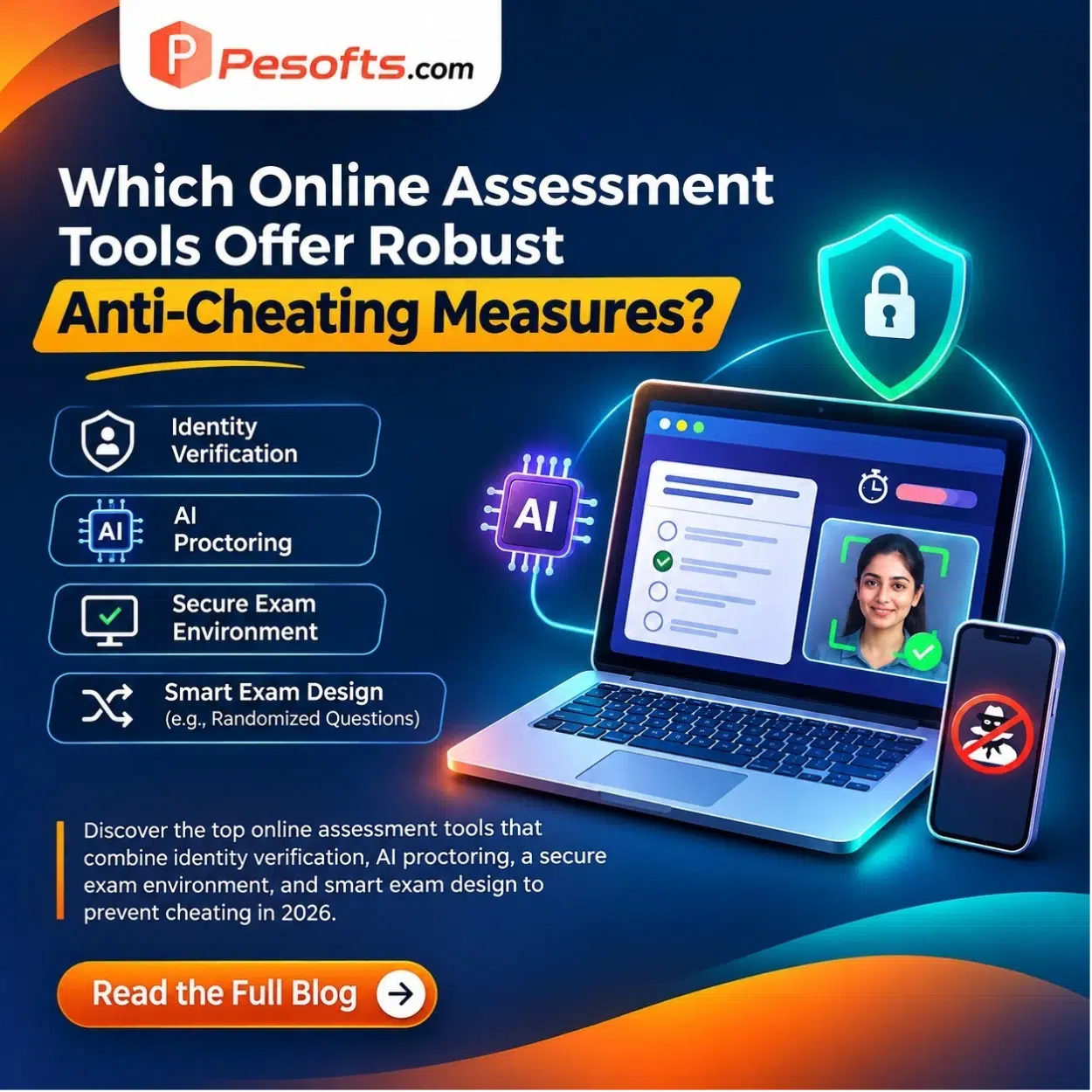
The online assessment tools with the most robust anti-cheating measures combine four layers: identity verification, AI proctoring, a secure exam environment, and smart exam design such as randomized question pools. No single feature stops every cheater in 2026, so the right tool is the one that layers them and gives you evidence you can review.
Let’s be honest: you’re probably reading this because someone on your team asked, “Can students just open ChatGPT on their phone?” Fair question. Let’s talk about it like adults.
Why anti-cheating got harder in 2026
A few years ago, cheating meant a whisper or a cheat slip. Now the tools are quieter. Industry guides this year point to AI assistants drawn as see-through overlays on the exam screen, camera-equipped smart glasses, second phones, remote-desktop helpers and impersonation services. Fora Soft’s 2026 analysis makes an important point: lockdown logs and similarity checks create friction and evidence, but none of them is proof, and a second device can beat them.
That doesn’t mean “give up.” It means stop buying one feature and hoping.
The 4-layer test: what “robust” actually means
1. Identity checks (before the exam). Face match against a registered photo, ID capture, and one-time login codes. If you can’t prove who is sitting the test, nothing else matters. Pesofts runs face recognition before the paper starts.
2. AI proctoring (during the exam). Webcam and microphone monitoring that flags multiple faces, a missing candidate, suspicious audio and repeated looking away, then sends flagged moments to a human to review. Good systems avoid auto-failing students; they raise a flag and show the clip. Many tools in 2026 also blend AI with human reviewers to cut false alarms.
3. Secure environment. Full-screen enforcement, tab-switch and window-change alerts, copy-paste blocking, and session recording. Ask any vendor whether they can detect or restrict a second device, virtual machines and AI overlays. Honest vendors will explain limits.
4. Exam design. This is the cheapest and most durable defense. Large question banks, shuffled questions and options, per-student random papers, tight timers and application-based questions that are hard to paste into a chatbot. Eklavvya’s guide calls large question pools the most cost-effective measure, and we agree.
Quick comparison: types of online assessment tools
| Tool type | Strong at | Watch out for | Best for |
|---|---|---|---|
| Enterprise hiring assessment platforms (e.g., iMocha, Talview) | Deep proctoring analytics, skills libraries | Per-candidate pricing, global focus | Corporate hiring |
| Dedicated proctoring services (e.g., ProctorU) | Live human proctors, high-stakes exams | Cost, installs or extensions | Universities, certification |
| Quiz and exam makers (e.g., OnlineExamMaker) | Ease of use, teacher settings | Lighter proctoring depth | Classroom tests |
| White-label exam platforms with built-in proctoring (e.g., Pesofts) | Your own branded web and app, built-in proctoring, payments, local languages | Confirm depth of proctoring signals during demo | Coaching institutes, colleges, corporates |
A 10-point checklist before you buy
- Does it verify identity before the test starts?
- Which exact signals does proctoring flag (faces, audio, tab switch, screen)?
- Is there a human review step for flags?
- Can it shuffle questions and options per student?
- Does it record sessions, and for how long are they stored?
- How does it handle mobile exams and low bandwidth?
- What happens if the internet drops mid-exam (auto-save, resume)?
- Where is data hosted, and can you export a backup?
- How does it address privacy and consent (including GDPR-style rules and EU AI Act timelines if you serve Europe)?
- Can you try it free, at your real student scale, before paying?
How Pesofts approaches anti-cheating
Pesofts is built mainly for coaching institutes, schools, colleges and corporates, with a strong India focus. Based on what we offer today:
- Built-in proctoring on live tests, with face recognition before the paper starts.
- Concurrent live tests with proctoring, so many batches can run at the same time.
- White-label web and mobile apps (Android and iOS), so students sit exams inside your brand.
- Questions in any language, including local languages, for objective and subjective papers.
- Quick reports and answer keys right after the test, plus SMS and email reminders.
- Cloud hosting on AWS, Azure and Google Cloud, with data backup downloads available.
- Mock-test support for exams such as JEE, SSC CGL, IBPS PO, RRB and CSIR NET.
- [Confirm and list]: the exact proctoring signals (tab-switch alerts, multiple-face detection, audio, screen/session recording, question and option shuffling, mobile-device detection).
Want to see it on your own batch of students? Book a free demo or check pricing.
What about ChatGPT and other AI tools?
Be realistic. No software can fully stop a student with a second phone off camera. What works is stacking layers: camera angle and environment checks, short timers, randomized papers, and questions that test reasoning rather than recall. Then use proctoring evidence to review flagged attempts, not to punish automatically.
Privacy and fairness: don’t skip this
Tell students what is recorded, why, and for how long. Offer an accessible alternative where needed. Early proctoring tools earned criticism for false flags and bias, so choose a system where a human makes the final call.
The 2026–27 outlook
Expect more demand for risk-based proctoring (light checks for low-stakes quizzes, heavy checks for finals), detection of AI overlays and secondary devices, and clearer regulation around AI monitoring. One industry estimate puts the online proctoring market near $1.8 billion in 2026, so competition and feature claims will keep rising. Ask vendors for demos, not slogans.
FAQs
Which online assessment tools offer robust anti-cheating measures? Tools that combine identity verification, AI proctoring, a secure exam environment and randomized question pools. Examples across categories include iMocha, Talview, ProctorU and white-label platforms like Pesofts. Always test against your own exam format.
Can online exam software detect ChatGPT use? Not directly in most cases. It detects behavior (looking away, second faces, tab switching) and reduces opportunity through shuffled, time-limited, application-based questions.
Is AI proctoring accurate? It is good at flagging, not at judging. Pair it with human review.
Does Pesofts have proctoring? Yes. Pesofts offers built-in proctoring with face recognition before the exam. See the proctoring page.
Can I run exams in regional languages? Yes. Pesofts supports question papers in any language.
Is there a free demo? Yes, you can request one here.
Final thoughts
The most robust tool isn’t the one with the longest feature list; it’s the one that matches your exam’s stakes, your students’ devices and your budget. Start with the checklist, run a pilot, and review the evidence. Ready to try? Get a free Pesofts demo.
Manjeet Mehta CEO @Pesofts
Manjeet Mehta is a professional writer and also the CEO @Pesofts. He passed out from IIT Roorkee in 2013 and started their own business, thinking of the growing education sector with the help of technology. You can check out LinkedIn and follow him here LinkedIn
Welcome to Pesofts
At Pesofts, we revolutionize the way educators conduct exams with our cutting-edge online exam software. Our platform streamlines test creation, administration, and evaluation, offering a seamless and efficient experience. Empower your educational institution with Pesofts and enhance the learning journey with innovative solutions tailored for modern teaching needs.
